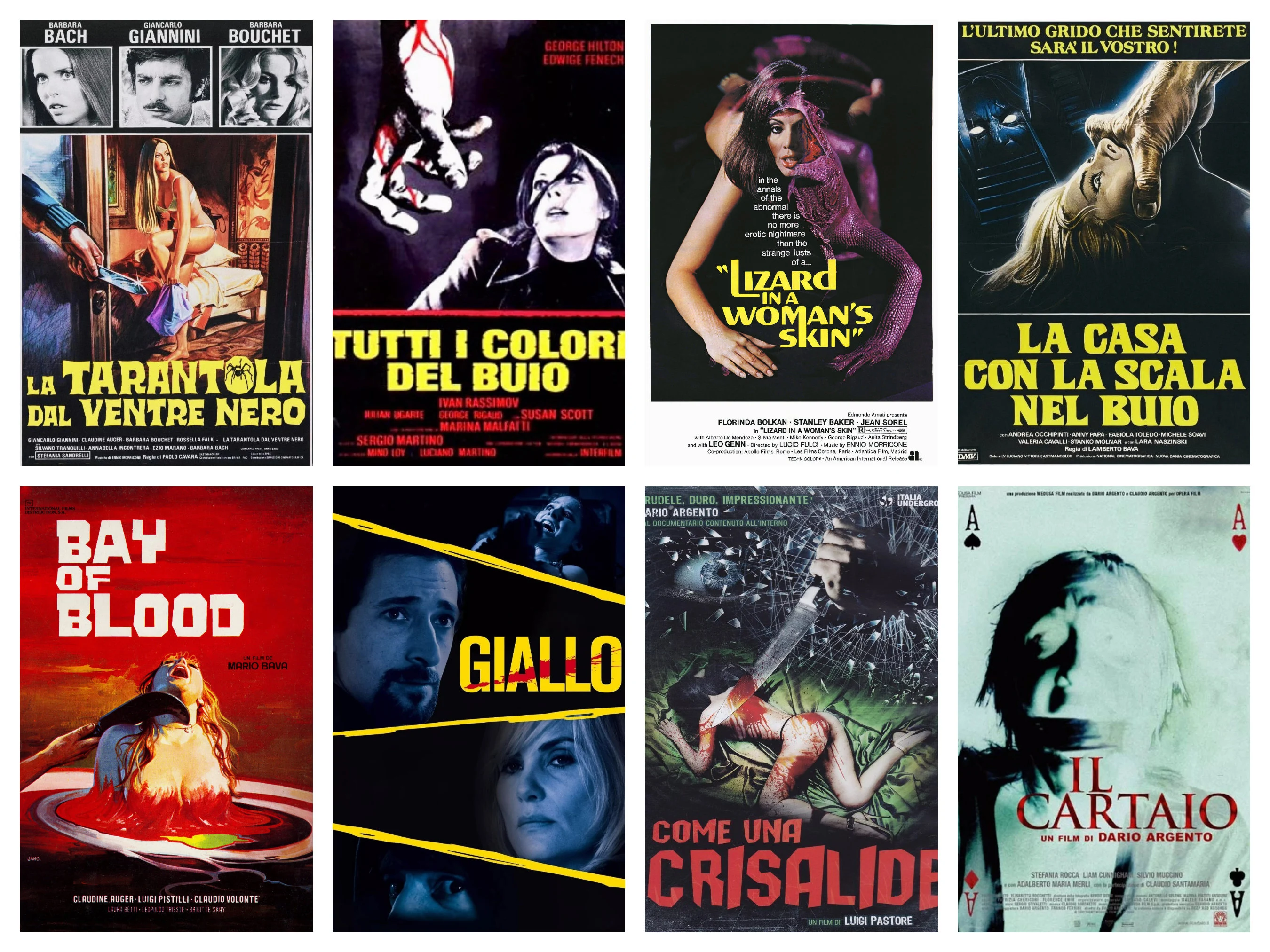
During the 31 Days of Horror, we wandered into the strange, seductive world of giallo—those vividly stylised Italian murder mysteries that blur the line between art and nightmare. But what exactly is giallo? What does the word even mean? And what makes it so different from the usual slashers or psychological thrillers we’re used to?
The word giallo literally means “yellow” in Italian, a nod to the bright yellow covers of mid-20th century pulp crime novels that inspired the genre. At its core, giallo sits somewhere between a murder mystery and a hallucinatory nightmare—it’s part detective story, part erotic thriller, and part surreal horror. You’ll find masked killers in leather gloves, haunting soundtracks (Goblin, anyone?), and enough colour-saturated visuals to make your eyes dilate. What sets giallo apart is its obsession with the intertwining of beauty and violence, where every murder is staged like a macabre painting, and emotion often takes precedence over logic.
For longtime horror fans, giallo is an acquired taste. But if you’re new to it, and you’re drawn to the artistry of horror as much as the blood and suspense, then it’s absolutely worth exploring.
When most people think of Italian giallo, the first name that comes to mind is Dario Argento, and for good reason. The man’s style, his flair for murder, and kaleidoscopic visuals practically define the genre. But giallo cinema extends far beyond Argento. Over 300 giallo films have been made in Italy’s decades-long love affair with stylish, brutal, and psychologically unhinged horror. Italian filmmakers have spent decades refining the art, and the genre has evolved into a world where murder is glamorous, grotesque, and disturbing.
For this Sunday Brew, we’re taking a closer look at the world of giallo—beyond Dario Argento’s blood-soaked spotlight. There’s a whole universe of filmmakers, styles, and strange beauty that helped shape this genre into something that’s as hypnotic as it is horrifying. We’ll dig into what makes giallo tick—the mood, the colour, the obsession with detail and design—and why these films still cast a spell on audiences decades later.
And of course, it’s not for everyone. Some might find it too over-the-top, too cheesy, or too graphically violent—and that’s perfectly fine. Giallo is meant to provoke, to unsettle, and sometimes even to confuse. But for those willing to surrender to its strange rhythm and striking visuals, it offers something that no other corner of horror quite matches: a beautiful, bloody nightmare dressed in style.
As I keep saying (and probably sounding like a broken record right now), I keep coming back to the style, the colour, the sheer visual flair—because in giallo, style is substance. The look, the lighting, the camera movement—all of it works together to pull you into a heightened world where logic fades and emotion takes over. The genre doesn’t just tell a story; it paints one. That’s what makes giallo so unforgettable, it’s not just what happens, but how it’s shown that gets under your skin. In my mind, it’s pure visual seduction. Films like Bava’s Blood and Black Lace (1964) don’t just show murders—they stage them. The camera caresses victims in electric blues and reds, turning every frame into a twisted fashion shoot. Aldo Lado’s Short Night of Glass Dolls (1971) drapes Prague in cold, dreamlike elegance while a dead man narrates his own autopsy. Giuliano Carnimeo’s The Case of the Bloody Iris (1972) pairs pop-art colours with mirror tricks and Edwige Fenech’s mesmerising paranoia. And Sergio Martino’s All the Colours of the Dark (1972) amps up the psychedelic chaos: reality dissolves into cult rituals and hauntingly stylish hallucinations.
Yet giallo is far more than eye candy. Some of its most memorable entries confront cruelty and trauma head-on. Lucio Fulci’s Don’t Torture a Duckling (1972) exposes the rotten underbelly of a sun-soaked village: child murders, religious hypocrisy, and social critique interweave to produce horror that strikes not just the eyes, but the conscience. Massimo Dallamano’s What Have You Done to Solange? (1972) uses sexual repression, boarding-school secrets, and tragedy to make its violence feel uncomfortably real. Lado’s Who Saw Her Die? (1972), set amid Venice’s fog-laden canals, delivers suffocating dread, where innocence itself seems endangered. Martino’s Torso (1973) tightens the screws even further, trading mystery for pure, stalking tension and an unrelenting sense of panic.
Italian cinema also produced other hidden gems that remain criminally overlooked. Pupi Avati’s The House with Laughing Windows (1976) slowly poisons viewers with rural decay and obsession, culminating in a finale that lingers long after the credits roll. Duccio Tessari’s The Bloodstained Butterfly (1971) experiments with courtroom drama and narrative perspective, crafting a cerebral thriller that resonates emotionally. Francesco Barilli’s The Perfume of the Lady in Black (1974) plunges into psychological breakdown, warping reality until paranoia itself becomes the antagonist. And Aldo Lado’s Night Train Murders (1975), bordering on giallo, delivers unfiltered cruelty, social tension, and extreme violence. A reminder that the genre isn’t just entertainment; it’s an ethical confrontation with human depravity.
For those brave enough to dive in and just want a primer, here is my short, curated viewing journey that guides one from seductive visuals to full psychological collapse. Begin with Blood and Black Lace, The Case of the Bloody Iris, and The Fifth Cord (1971, Luigi Bazzoni) to appreciate giallo’s aesthetic mastery. Then descend into the brutal horrors of Don’t Torture a Duckling, What Have You Done to Solange?, Who Saw Her Die?, and A Quiet Place in the Country (1968, Elio Petri), where tension, dread, and morally complex violence dominate. Finally, reach the psychological apex with The Bloodstained Butterfly, The House with Laughing Windows, and The Perfume of the Lady in Black, where reality warps, paranoia festers, and the mind itself becomes the most dangerous killer. For a final plunge into nihilistic horror, The Killer Must Kill Again (1975, Luigi Cozzi) erases moral distance, leaving viewers shaken and morally implicated.
To make the giallo experience even richer, you can pair these Italian films with non-Italian horror that shares their themes or mood. Blood and Black Lace lines up beautifully with Michael Powell’s Peeping Tom (1960), both exploring murder as art and the dark allure of the voyeuristic gaze. A Lizard in a Woman’s Skin (1971) clicks with Polanski’s Repulsion (1965), where sexual repression and psychological collapse spiral together. Don’t Torture a Duckling (1972) finds a kindred spirit in The Wicker Man (1973), revealing rural hypocrisy and cultish moral extremes. The Perfume of the Lady in Black pairs with Don’t Look Now (1973), two Venetian tales of grief, paranoia, and hallucination.
The Killer Reserved Nine Seats (1974, Giuseppe Bennati) anticipates the claustrophobic tension of Black Christmas (1974), while The House with Laughing Windows resonates with The Vanishing (1988), delivering a slow, inescapable sense of dread. And for sheer, unflinching brutality, The Sister of Ursula (1978, Enzo Milioni) and Henry: Portrait of a Serial Killer (1986) confront human evil head-on, without compromise. Pairing giallo with these films shows how its themes—style, suspense, and the dark heart of human nature—echo across the wider world of horror.
Italian giallo is far more than lurid titles. Whether you seek to admire the genre’s beauty, confront its cruelty, or uncover hidden gems, these films prove that giallo is not just a style—it is an invitation to explore the darkest corners of the mind.
Trying to dive into giallo can feel like stepping into a hall of mirrors with hundreds of films clawing for attention, each promising mystery, murder, and madness. It’s no wonder newcomers don’t know where to begin. Most paths lead straight to Dario Argento—and fair enough, his fingerprints are all over the genre’s DNA—but to stop there would be like thinking Italian horror starts and ends with Suspiria.
If you’re ready to dive headfirst into the blood-soaked, beautifully twisted world of Italian giallo—and explore films beyond Argento—then this binge is for you. Dim the lights, settle in (as best you can), and get ready for a carefully put-together murder menu. Each film hits differently: some will stun your eyes with lurid, stylish violence, others will mess with your sense of right and wrong, and a few will quietly burrow under your skin long after the credits roll.
To make it easier to navigate, and for those who want a full experience and not the primer that I mentioned earlier in this article, I’ve put together a list where every choice is intentional and meant to take you on a journey—some showcase giallo’s unforgettable visual flair, others its psychological tension, and some reveal the darker side of its world. The order isn’t random either; it’s structured to give a sense of the genre’s variety, its mood swings, and the ways it continues to captivate. By the end, you’ll see why giallo isn’t just a type of horror—it’s an experience.
The Ultimate Giallo Beginner’s Binge Table
Act I – The Seduction (Visually Stunning, Style-Heavy)
Step into the neon-lit catwalks of murder and fashion.
Blood and Black Lace (1964, Mario Bava)
Intensity: ★★★☆☆
Mood: Lurid glamour meets slasher spectacle
Every murder is a fashion statement—watch colours scream as bodies fall.
The Case of the Bloody Iris (1972, Giuliano Carnimeo)
Intensity: ★★☆☆☆
Mood: Pop-art paranoia
Mirrors, reflections, and paranoia: Edwige Fenech steals every frame.
All the Colours of the Dark (1972, Sergio Martino)
Intensity: ★★★★☆
Mood: Psychedelic descent
Reality warps, hallucinations strike, and cult rituals abound.
A Lizard in a Woman’s Skin (1971, Lucio Fulci)
Intensity: ★★★★☆
Mood: Surreal eroticism
Sexual obsession and hallucinatory murder blur the line between fantasy and reality.
Hatchet for the Honeymoon (1970, Mario Bava)
Intensity: ★★★☆☆
Mood: Stylish obsession
Wealth, desire, and murder collide in a visually lavish psychodrama.
Forbidden Photos of a Lady Above Suspicion (1970, Luciano Ercoli)
Intensity: ★★★★☆
Mood: Sleek erotic suspense
Photography, obsession, and a deadly plot mix in a perfectly polished thriller.
Your Vice Is a Locked Room and Only I Have the Key (1972, Sergio Martino)
Intensity: ★★★★☆
Mood: Erotic tension meets suspense
Psychological obsession escalates to murder in a stylish, cinematic maze.
Death Carries a Cane (1973, Maurizio Pradeaux)
Intensity: ★★★☆☆
Mood: Urban mystery
A city cloaked in shadows hides a killer with a taste for theatrics.
The Red Queen Kills Seven Times (1972, Emilio Miraglia)
Intensity: ★★★★☆
Mood: Gothic intrigue
Family secrets, revenge, and lurid colour make every scene a visual feast.
Act II – The Brutality (Violence & Moral Decay)
Where suspense meets moral rot—innocence isn’t safe.
Don’t Torture a Duckling (1972, Lucio Fulci)
Intensity: ★★★★★
Mood: Sun-soaked evil
Child murders, hypocrisy, and social critique pierce the heart as well as the eyes.
What Have You Done to Solange? (1972, Massimo Dallamano)
Intensity: ★★★★☆
Mood: Boarding-school dread
Secrets, repression, and tragedy make every act of violence feel painfully real.
Who Saw Her Die? (1972, Aldo Lado)
Intensity: ★★★★☆
Mood: Venice as purgatory
Foggy canals hide more than just crime—fear lingers in every shadow.
Torso (1973, Sergio Martino)
Intensity: ★★★★☆
Mood: Relentless tension
A proto-slasher that turns every hallway into a panic chamber.
Seven Blood-Stained Orchids (1972, Umberto Lenzi)
Intensity: ★★★★☆
Mood: Exotic and relentless
A globe-trotting hunt for a killer with a flair for the dramatic.
Strip Nude for Your Killer (1975, Andrea Bianchi)
Intensity: ★★★★☆
Mood: Sleazy, relentless
Glamour and gore combine in a high-fashion slasher with a raw edge.
The Night Evelyn Came Out of the Grave (1971, Emilio Miraglia)
Intensity: ★★★★☆
Mood: Gothic suspense
Haunted estates, masked killers, and family secrets collide in a decadent display of murder.
The Iguana with the Tongue of Fire (1971, Riccardo Freda)
Intensity: ★★★☆☆
Mood: Erotic and sinister
Exotic locations, stylised murders, and lurid visuals keep the tension high.
A Black Ribbon for Deborah (1974, Marcello Andrei)
Intensity: ★★★★☆
Mood: Supernatural paranoia
Obsession, murder, and a hint of the occult blend into tense, stylish suspense.
Act III – Psychological Collapse (Mind-Melting Horror)
Dive deep into paranoia, obsession, and the darkest corners of the human mind.
The Bloodstained Butterfly (1971, Duccio Tessari)
Intensity: ★★★☆☆
Mood: Cerebral and tragic
Courtroom drama meets giallo terror—logic and horror collide.
The House with Laughing Windows (1976, Pupi Avati)
Intensity: ★★★★★
Mood: Slow-burn rural nightmare
Obsession and decay creep in, lingering far beyond the finale.
The Perfume of the Lady in Black (1974, Francesco Barilli)
Intensity: ★★★★★
Mood: Surreal paranoia
Reality bends; paranoia becomes the predator.
The Killer Must Kill Again (1975, Luigi Cozzi)
Intensity: ★★★★★
Mood: Nihilistic horror
Human cruelty stripped bare—this is giallo at its rawest.
Death Walks on High Heels (1971, Luciano Ercoli)
Intensity: ★★★★☆
Mood: Erotic mystery
Stylish, suspenseful, and full of twists, this one is perfect for newcomers.
The Sister of Ursula (1978, Enzo Milioni)
Intensity: ★★★★★
Mood: Raw human evil
Uncompromising violence and obsession—giallo stripped to its darkest core.
The Fifth Cord (1971, Luigi Bazzoni)
Intensity: ★★★★☆
Mood: Urban dread
A tense, stylish thriller where every clue drags the audience deeper into paranoia.
Footprints on the Moon (1975, Luigi Bazzoni)
Intensity: ★★★★☆
Mood: Surreal isolation
Lunar obsession and psychological terror in a rural, mysterious setting.
Seven Notes in Black (1977, Lucio Fulci)
Intensity: ★★★★☆
Mood: Paranoia and obsession
A hypnotic descent into foreboding visions and tragic inevitability.
A Quiet Place in the Country (1968, Elio Petri)
Intensity: ★★★★☆
Mood: Psychological unraveling
Isolation, obsession, and artistic madness collide in an eerie rural setting.
The House on the Edge of the Park (1980, Ruggero Deodato) (borderline giallo/horror)
Intensity: ★★★★★
Mood: Brutal urban terror
Human cruelty and social decay taken to terrifying extremes.
Giallo has always thrilled me with its mix of style, suspense, and sheer unpredictability. There’s something about the way these films balance beauty and terror, glamour and gore, that keeps me coming back—even when I think I know what’s coming. But enough from me—I really want to hear from you.
Which films made your pulse race or left you squirming in your seat? Which twists completely blindsided you, or which ones did you see coming a mile away?
Do you have a favorite director, a scene that still haunts you, or a movie you think is totally overrated? Share your thoughts, your theories, even your guilty pleasures—I’m genuinely curious.
After all, in giallo, the real thrill isn’t just in the story on screen but in the stories we tell each other about them. So let’s talk, debate, and maybe even uncover a few mysteries together.

Leave a Reply