Hey Nightwalkers!
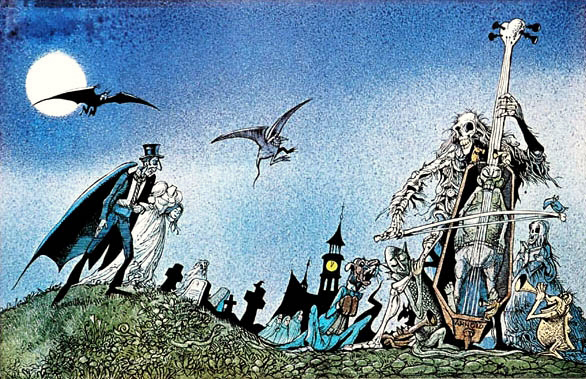
It’s been quite the few weeks with some health issues, but that doesn’t mean the world of cinema has halted for me. While under the weather, I threw on Hans Arnold: Art of the Witchmaster, expecting a quirky doco about an eccentric illustrator, and instead got pulled straight into the mind of a bloke who blended nightmare fuel, fairy-tale sweetness, and pure psychedelic chaos into something unmistakably his. Hans Arnold, a Swiss-born artist who later became a Swedish cultural fixture, was one of those artists everyone recognises, even if they don’t realise why. He did children’s books, theatre scenography, erotic line drawings, surreal magazine horrors — even the ABBA Greatest Hits cover, which still cracks me up because it’s such an odd crossover.
The doco covers the last four years of Arnold’s life, stitched together with interviews, old TV appearances, family stories, and a mountain of his art. You can tell it took ages, and the director clearly wanted to follow Arnold rather than just record him. The result’s surprisingly intimate. You’re not just told who Arnold was; you watch him think, joke, and wander through the ideas that shaped him.
His Swiss childhood comes up a lot — strict Catholic upbringing, guilt, devils, hellfire imagery — classic ingredients for someone who’d later draw things that look like they crawled out of the back of a maniacal mind. What’s wild is how self-aware he is about it. He doesn’t treat those memories as trauma; he treats them as material. His daughter pops up at one point to gently roast him about the sexual undertones in his art, which is hilarious given how bizarre some of those images get.
The film dives into his long run with Vecko-Revyn, where he created “Shock of the Week” every week for about twenty-five years. The output is ridiculous — thousands of pieces, all detailed, twisted, unmistakably him. Then the doco swings to his softer side: children’s illustrations, fairy-tale work, stage and opera visuals, animation. It’s a strange but very Arnold mix — the bloke could go from cute elves to erotic demons without missing a beat.
One thing the film doesn’t hammer but you can’t help noticing, is how his work sat on the edge of film culture. His impact wasn’t creature design or concept art; he shaped the world around movies. A handful of Scandinavian horror and genre films used his artwork for posters — including a Swedish Horror of Dracula poster — and those mattered more than people think. Posters are the first hit of atmosphere, and Arnold’s didn’t just sell movies; they reframed them. They made films stranger, darker, and more enchanted than the studio shots ever did. It’s that old illustrated-poster tradition — horror defined by brushstroke instead of Photoshop — and Arnold was part of the tail end of that era.

Then there’s his TV and animation work, plus scenography and stage design. Even though it wasn’t feature films, the visual language he built seeped into screen culture. Watch enough mid-century European horror, fantasy, or kids’ TV, and you start spotting the curling lines, the lurking faces, the “cute but uneasy” vibe. Was every filmmaker studying Arnold? Probably not. But he was in the ecosystem, feeding the visual conversation.
One of the best parts of the doco is how much artwork it shows. It lets you sit with the images, notice the little faces in corners, the warped architecture, the tiny details that suggest stories behind stories. You could stare at one piece for ten minutes and still catch something new. Seeing that while hearing Arnold talk about his philosophy — blending horror with humour, making pictures feel alive — is properly engrossing.
What I didn’t expect was how emotional it gets. Toward the end, as Arnold reflects on his life, he comes across as someone who fought his demons by turning them into something beautiful — weird, cheeky, but beautiful — for decades. Friends and collaborators say he never fit neatly into any scene yet somehow became a staple of Swedish pop culture. You start realising he influenced far more people than he ever admitted.
By the end, it feels like you’ve been hanging out with the guy. He didn’t just make artwork; he built worlds he wandered through. The doco captures that — the joy and the darkness — without over-explaining or polishing it. It feels honest. Messy in the right ways. Full of life.
If you’re into surreal art, old-school illustration, European cult cinema, or you just enjoy peeling back the skull of a creative mind to see what’s ticking inside, this doco’s absolutely worth the spin. And if you fall down the Hans Arnold rabbit hole afterward… welcome to the club.

Last week, we (well, mostly I ) also wrapped up Noirvember with a slightly different approach, looking at some neo-noir and pondering what Citizen Kane has to do with noir. I’ve been marinating on that because there’s nuance there.
I’m not interested in rehashing everything already written — that film’s been dissected so thoroughly it’s basically an autopsy with bonus features. What grabs me is how Kane quietly cooks up the ingredients noir would later toss into the pan and scorch to perfection. It’s not a noir, sure, but every time I watch it, it feels like I’ve stumbled across the blueprint for a house I know well, only the walls aren’t up yet. The more I look, the more deliberate it feels — as if Welles accidentally summoned noir while telling the story of one incredibly damaged bloke.
But my own personal feelings on this aside, Orson Welles wasn’t trying to invent noir; he was just telling the story of one man who became his own prison. But the way the film leans into darkness, into uncertainty, into structures that dwarf the human beings inside them, those deep-focus shots, the shadows stretching across walls, the sense that every room might conceal something you shouldn’t see — it all prefigures the tone that later noir directors would crank up until the whole frame felt like it might collapse under its own guilt.
Those shadows aren’t just dramatic; they’re doing half the psychological work. Kane, strolling through Xanadu, feels like he’s already living inside the moral gloom that characters in Out of the Past or The Big Combo drown in. Noir uses shadow to show guilt; Kane uses it to show the absence of love, clarity, and purpose. It’s hard not to imagine the makers of Double Indemnity taking one look at the deep-focus setups and saying, “Yep, we’ll have that.”
Then there’s how Welles frames power. Noir usually shows men crushed by systems — corrupt cops, greedy bosses, crime syndicates. In Kane, the “system” is Kane himself, and he’s still crushed by it. It flips the noir dynamic: instead of the little guy being ground down, the giant is hollowed out. Kane, dwarfed by his own office, reminds me of the haunted rich in The Big Sleep. Xanadu feels like noir architecture in overdrive — every echo asking questions you don’t want answered.
The narrative structure is pure proto-noir too. Fragmented memories, unreliable witnesses, biased testimony — classic noir long before the term stuck. Thompson’s chase for meaning could drop straight into Laura or The Killers.
Noir usually gives a bleak answer; Kane gives a burning sled and a shrug.
Noir says, “The truth hurts.”
Kane says, “Good luck finding it, champ!”
Psychologically, Kane is the prototype doomed noir protagonist: Dix Steele without the bar fights, Walter Neff without the insurance scam, Frank Chambers without the sweaty motel. The crime is emotional neglect, the body count internal. There’s no femme fatale — he derails himself. It’s Scarlet Street in reverse: Kane is both a deluded artist and a corrupting force. Trying to sculpt Susan into a star is a noir spiral without the smoky nightclub entrances.
Information itself becomes noir. Instead of crooked officials hiding secrets, Kane bends reality through headlines. It’s the spiritual prequel to Sweet Smell of Success, where reputation becomes the deadliest weapon. Noir eventually caught on: sometimes the villain doesn’t need a gun, just a printing press.
Watching it from Australia, where we’ve always had a healthy suspicion of big myths and bigger egos, Kane feels like the moment American cinema admitted that its own narratives weren’t as clean as they pretended. Noir later codified that unease with crime, corruption, and doomed characters. Kane just sat there in 1941, muttering, “Yeah, it’s messy. Deal with it.” Kane’s self-mythologising is massive, but the collapse underneath is universal.
Which makes me wonder: are all those noir gumshoes and grifters just scrappier echoes of Kane? Same downfall, less real estate, fewer exotic animals. Noir tightens the shadows, but the ache is the same — no one really knows themselves.
Here’s the question that sticks: noir shows little people crushed by big systems. If Kane — a man who is the system — gets crushed anyway, what does that say? Does that make him the ultimate noir figure, the accidental prototype? Or just proof that no amount of money or power saves you from the parts of yourself you refuse to face?
Maybe that’s the most noir idea of all. If even the biggest bloke in the room can’t outrun his shadows, what hope does anyone else have? Maybe that’s why noir resonated: audiences recognised the truth in Kane’s downfall, even if they never lived in a mansion or ran a newspaper empire.
Either way, Citizen Kane ends up feeling like noir’s first accidental confession. The real mystery isn’t Rosebud. It’s the man who burned every bridge and still wondered why he ended up alone. And that’s where neo-noir bursts in — a genre that didn’t so much evolve as it reacted. By the 1970s, the world wasn’t humming with optimism; it was coughing up scandals, wars, economic crises, and a public that no longer trusted the people running the show. Noir, which had always thrived on cynicism and moral ambiguity, suddenly had the perfect cultural soil. The shadows grew taller, the characters grew more damaged, and the cityscapes turned hostile.
Neo-noir wasn’t about fedoras anymore; it was about systems collapsing and individuals slipping through the cracks. Films like Chinatown made Los Angeles look like a moral wasteland, while The Parallax View wrapped paranoia in corporate glass and steel. Even journalism got the noir treatment in All the President’s Men, where the tension came from documents rather than guns but felt just as suffocating. The private eye returned, too, but he’d lost the swagger — Hackman’s PI in Night Moves admits he doesn’t solve anything, he just shuffles the debris. Gould’s Marlowe drifts through a bankrupt moral landscape in The Long Goodbye, half-aware he’s a relic.
Cities themselves became characters. Taxi Driver dropped Travis Bickle into decay until his psyche matched the streets. Scorsese’s Mean Streets simmered with guilt and crime, and even a period piece like Farewell, My Lovely felt rooted in the same rot. Overseas, Britain channelled class tensions into brutal tales like Get Carter, while films such as The Conversation turned electronic surveillance into a new kind of dread. Noir kept stretching, bending, merging with horror, sci-fi, existentialism — anything that felt honest about a world coming apart.

Globally, the genre fractured and exploded. Europe, Japan, Latin America — everyone had their version of a society cracking under pressure, and filmmakers answered with stories that were darker, stranger, and more confrontational than anything that came before. Neo-noir wasn’t just a stylistic shift; it was a cultural confession. It said, “We’re not okay, and we’re not going to pretend otherwise.”
When you fold that back into Citizen Kane, the lineage feels obvious. Kane offered the prototype: a man undone by his own myth, trapped inside his own architecture, haunted by memories he could never organise into something that made sense. Neo-noir took that psychological core and dropped it into a world where the institutions themselves were failing. If Kane is the accidental ancestor, neo-noir is the heir who took the lessons and sharpened them.
Why does it still matter?
Because the shadows haven’t gone anywhere. We still live in systems we don’t fully trust, cities that swallow people whole, and narratives that collapse under scrutiny. Neo-noir remains relevant because it refuses comfort. It doesn’t offer heroes; it offers survivors, and sometimes even they aren’t sure why they’re still standing.
In the end, whether it’s Kane staring into the emptiness of Xanadu or a neo-noir detective wandering through a city that smells like despair, the message is the same: the darkness isn’t external — it’s baked in. And again we wind back to the same question we asked before, if even the so-called biggest man in the room can’t outrun his shadows, what hope does anyone else have?
Maybe that’s the most noir idea of all. And maybe that’s why we keep coming back to it.
And on that note…that’s the wrap-up for this week, Nightwalkers — a bit of noir, a bit of weird art, and a fair dose of shadowy cinema to chew on.
With Christmas looming, things are about to slow right down. It’s that time of year when you take a breath, look at the calendar, and realise you’ve got a few quiet weeks to think about what direction to take next.
I’ll be mulling it over in the background — figuring out whether we keep digging into the darker corners, shift gears, or wander off into something completely different.
Either way, we’ll pick it up again soon. Stay sharp.
-S.


Leave a Reply